Australia's AI Ambition Is Growing. But Where Is the Return?
Studio Orris · · 6 min read

BUSINESS & TECHNOLOGY | STUDIO ORRIS INSIGHTS
As Australian businesses accelerate their investment in artificial intelligence, a more consequential question is emerging: how many can demonstrate that their digital investments are producing measurable commercial value?
Artificial intelligence has become a defining feature of the modern business conversation.
From customer service and marketing to financial administration, recruitment and operational planning, organisations are exploring how intelligent systems might reduce costs, accelerate decisions and reshape the way work gets done.
The opportunity is substantial. So too is the temptation to confuse technological activity with commercial progress.
A business may introduce AI across several departments, acquire new software subscriptions and encourage employees to experiment with emerging tools. Yet none of these developments, in isolation, demonstrates that the organisation is becoming more productive, profitable or competitive.
For Australian business leaders, that distinction is becoming increasingly important.
The gap between adoption and accountability
The Australian Bureau of Statistics' Characteristics of Australian Business report, released in June 2026, provides a revealing picture of how businesses are approaching digital technology.
During the 2024–25 financial year, 12% of Australian businesses reported using artificial intelligence.
Yet only 7% reported measuring the contribution of their digital activities to overall business performance. Just 10% indicated that they actively collected or analysed data to inform decisions.
These measures examine different aspects of business activity. They do not establish that AI users are failing to measure their returns.
They do, however, raise an important strategic question about the maturity of digital management practices.
Businesses are becoming increasingly interested in what technology can do. The harder challenge is determining what that technology is actually achieving.
The same ABS release found that 13% of businesses identified uncertainty around the costs and benefits of information and communication technologies as a factor limiting their use.
That uncertainty is not simply a technology problem. It is a business case problem.
More software does not necessarily mean better systems
Consider a growing professional services organisation.
Its client enquiries arrive through email, its project information is maintained across spreadsheets, and its employees use several separate platforms to manage communication, invoicing and customer relationships.
Management introduces an AI assistant to accelerate written responses and produce administrative summaries.
The immediate benefits may be visible. Employees can complete certain tasks more quickly, and some repetitive work becomes easier.
But important questions remain unanswered.
Are more enquiries becoming paying clients? Has the cost of servicing those clients decreased? Are employees using the recovered time productively? Can management identify the most profitable opportunities?
If the organisation cannot answer these questions, the commercial return remains uncertain.
This is a hypothetical but familiar management scenario: an individual task becomes more efficient while the wider operating model remains largely unchanged.
The greater opportunity may lie in redesigning the underlying process, connecting information across departments and establishing meaningful performance measures.
Artificial intelligence can support that transformation. It cannot independently determine the organisation's strategy.
Why the economic environment matters
The need for greater discipline is particularly relevant in the current operating environment.
The ABS reported that 30% of Australian businesses experienced lower profit margins, required to remain competitive, as a significant impediment to business performance during 2024–25.
For companies confronting pressure on profitability, technology investment should be approached with the same scrutiny applied to other significant commercial decisions.
The objective is not merely to reduce expenditure.
It is to ensure that investment improves the economic performance, resilience or long-term capacity of the organisation.
A customer service automation project, for example, might be assessed against response times, resolution rates, operating costs and customer satisfaction.
A recruitment technology investment might be evaluated through administrative hours saved, quality of decision-making, candidate experience and retention outcomes.
A new management information system should help leaders make better decisions, not simply produce more reports.
The relevant measures will differ between organisations.
What should remain consistent is the discipline of identifying them before implementation.
Four questions every executive should ask
At Studio Orris, we believe digital transformation is most effective when business strategy, operational design, people and technology are considered together.
For organisations reviewing their approach to AI, four questions provide a practical starting point.
1. What commercial problem are we solving?
Define the operational constraint or strategic opportunity before selecting the technology.
A vague desire to become an AI-enabled organisation is not a measurable business objective.
2. What will success look like?
Establish a baseline and identify specific indicators of improvement.
These might include cost per transaction, hours spent on administration, customer conversion, service quality or management reporting accuracy.
3. Is the underlying business ready?
Disconnected systems, inconsistent records and poorly designed processes can limit the benefits of automation.
Improving information quality and workflow design may be a necessary first step.
4. Who is accountable for the outcome?
Technology governance cannot be delegated entirely to software providers.
Australia's Guidance for AI Adoption , published by the Department of Industry, Science and Resources in October 2025, identifies accountability, risk management, transparency, testing and human oversight among the foundations of responsible adoption.
These should be considered alongside the expected commercial benefits.
The next competitive advantage
As sophisticated AI capabilities become more widely available, simply possessing the technology may become a weaker source of competitive differentiation.
Two businesses can purchase access to similar tools and achieve very different outcomes.
One may use them to accelerate isolated administrative tasks. The other may connect them to a deliberate operating model, redesign processes and continuously measure improvements.
The difference is not necessarily the technology.
It is the quality of leadership, implementation and organisational understanding surrounding it.
For smaller businesses, meaningful transformation may begin with a single well-selected workflow.
For larger enterprises, it may involve integrating previously disconnected systems, improving information governance and coordinating technology investment across several business functions.
Neither approach requires adopting new technology for its own sake.
Both require clarity about the business problem, the intended outcome and the evidence that will demonstrate success.
A more important question for Australian business
The next phase of Australia's AI development should be measured by more than announcements, software purchases and adoption rates.
The more meaningful indicators will be whether businesses are operating more effectively, improving customer outcomes, protecting margins and developing capabilities that support long-term growth.
For executives, the priority is therefore not simply to ask how quickly their organisation can implement artificial intelligence.
It is to ask whether that investment is making the organisation fundamentally better.
In the next era of business transformation, the advantage may belong not to those adopting the most technology, but to those creating the most measurable value from it.
A Studio Orris Perspective
Technology creates its greatest value when it works in service of a clear commercial strategy.
Studio Orris brings together business consulting, digital strategy and integrated technology solutions to help ambitious organisations navigate growth and operational change.
Explore Studio Orris Business & Enterprise Solutions at studioorris.com.au , or speak with our consulting team about your next stage of growth.
References
2. Australian Government — Guidance for AI Adoption: Implementation Practices
Related Insights
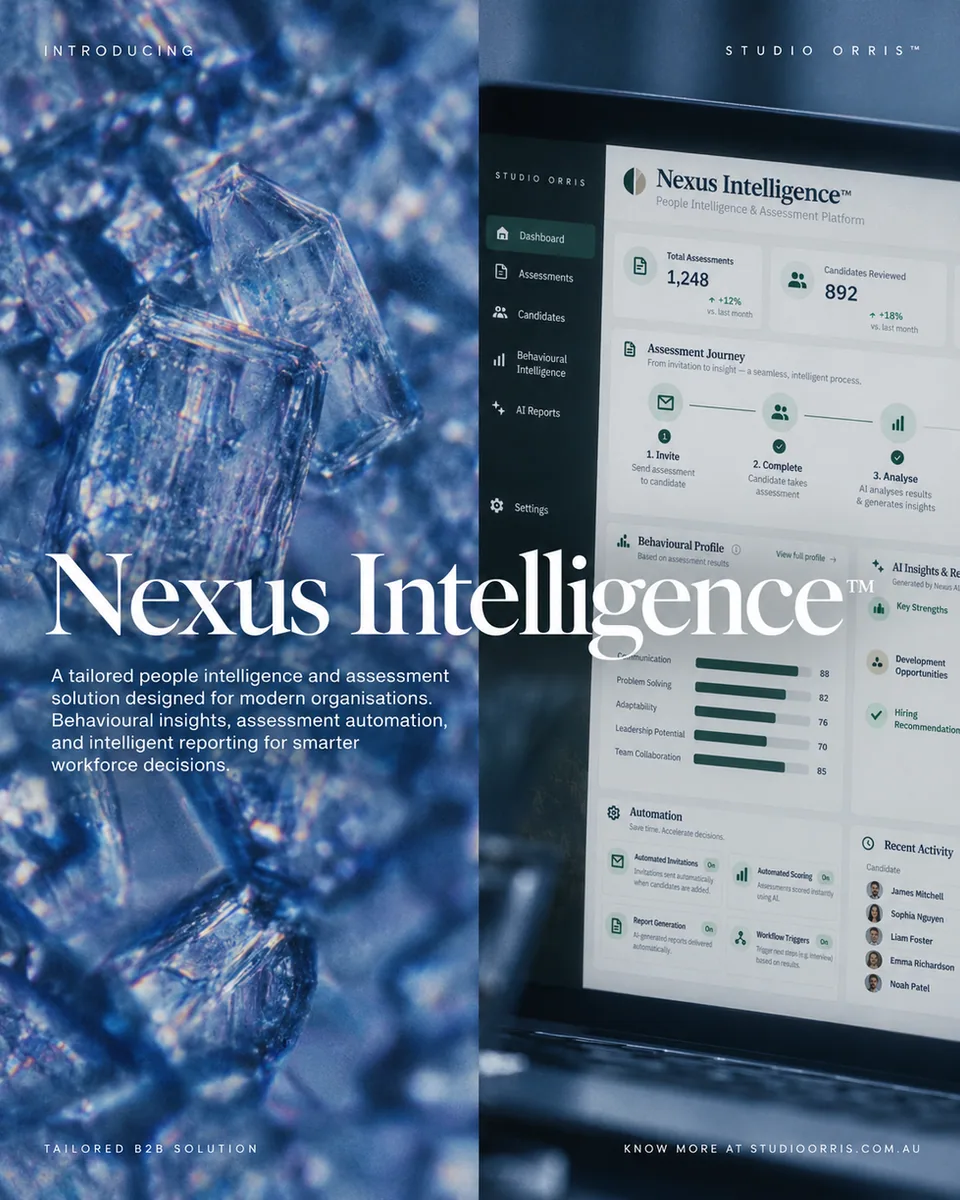
Studio Orris Launches Nexus Intelligence™ for Smarter People Decisions
Studio Orris · 10 September 2026

The Insolvency Plateau
Beatrice Sterling, MBA · 7 September 2026

Built Differently, Recognised Locally: Outside the Box Wins at the 2026 Brisbane City Local Business Awards
Studio Orris · 30 August 2026